While the actual Tsukiji Fish Market, famous for its tuna auctions early in the morning, may have moved to its new location in Toyosu, much of the Tsukiji outer market still exists and they continue to receive many visits from locals and tourists alike in order to experience Japanese food culture and specifically their fish-eating culture (Tominaga).

Upon arrival, it was clear that there were a few selections of seafood that was being heavily marketed, which included sea urchins, oysters and tuna, which by far was the most widely advertised food item in the market. This was evident when you see what was highlighted on the menus being shown outside the stores as well as how workers tried to draw people into their restaurant to eat.
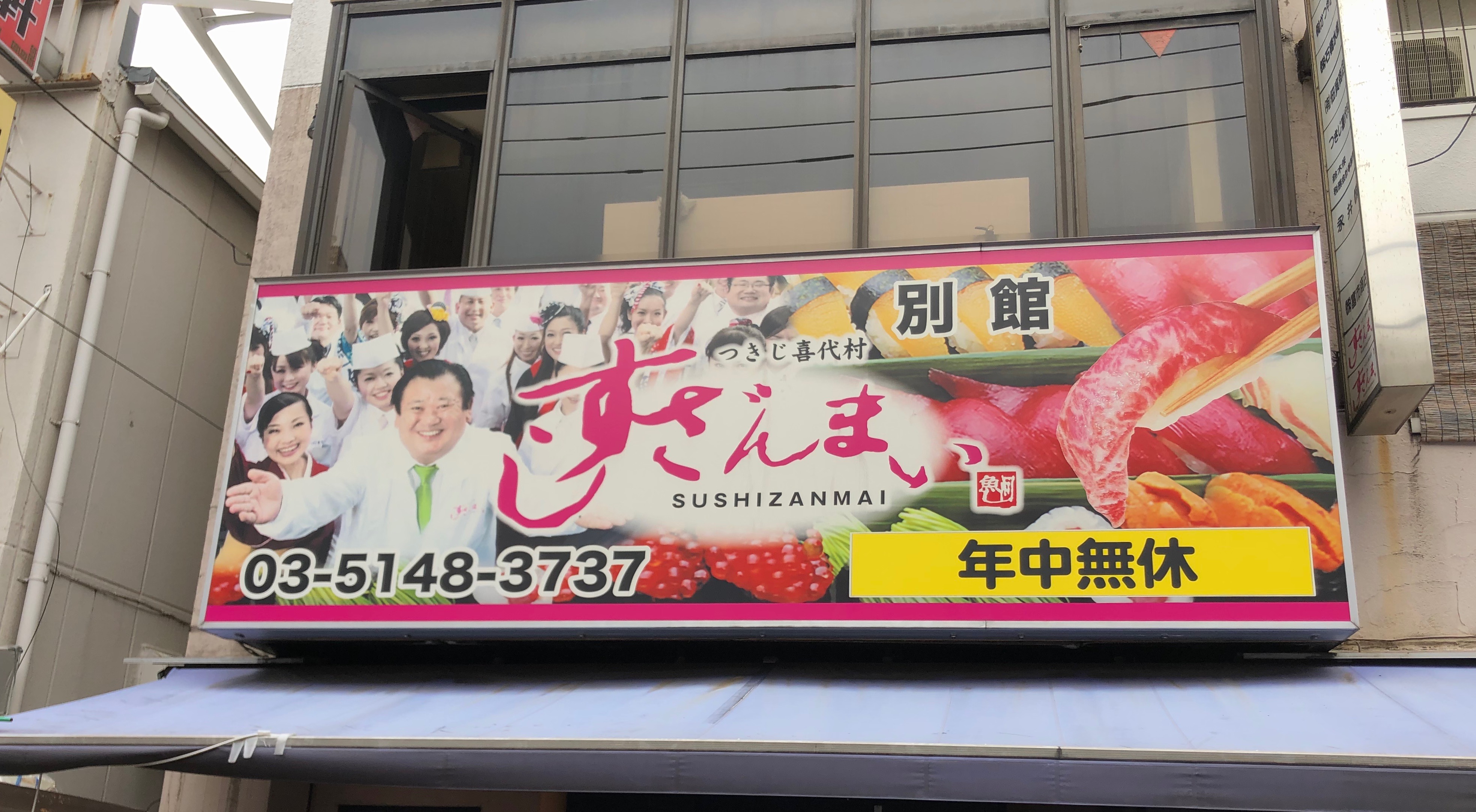
An advertisement for a sushi restaurant at the market 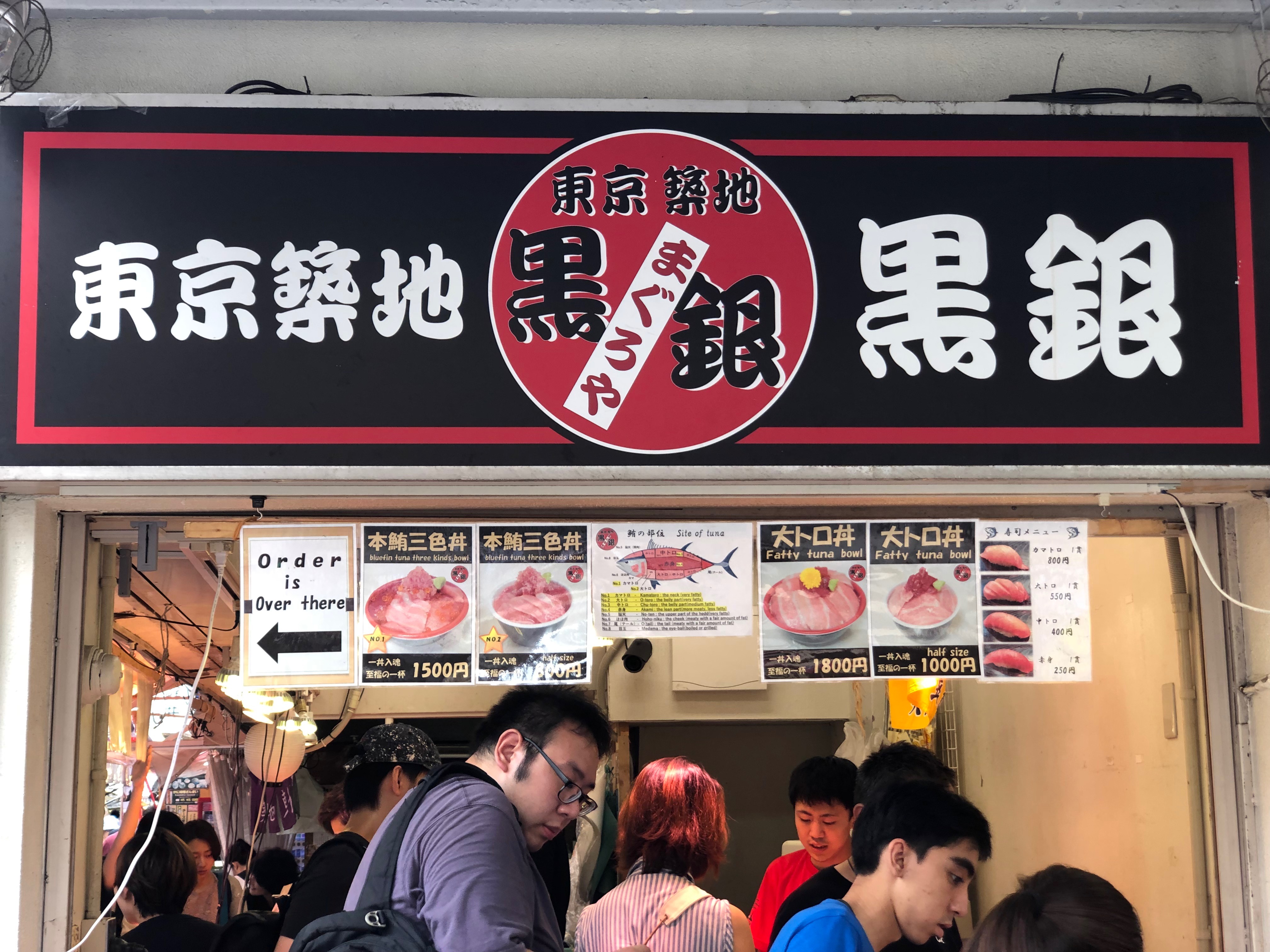
The storefront of a tuna bowl store in the market 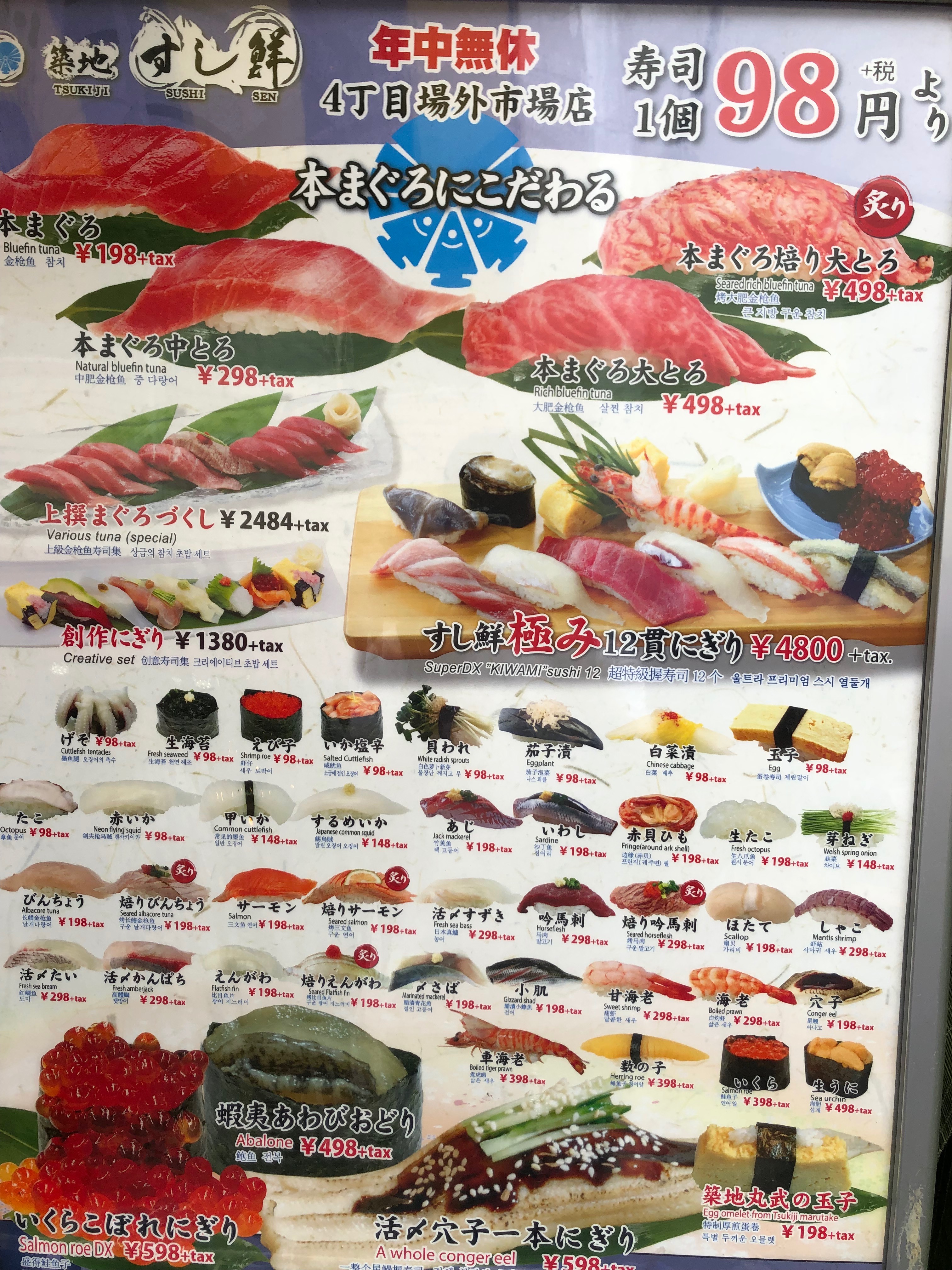
The menu of a sushi restaurant placed right outside its entrance
The first photo in this gallery is of a sign advertising a sushi restaurant and the main parts of the sign include the name, the chefs on the left and the fatty tuna sushi on the right. As such, we can see right from the beginning that tuna is a major selling point of this restaurant. The use of bright colours and lack of Japanese help to attract and signal to tourists that this store is likely to be serving tourists looking for tuna sushi in Tsukiji, which is unsurprising as it is such a popular tourist activity.
Going a bit deeper into the market, after passing by several other tuna sushi restaurants, a store selling tuna bowls can be found. I stopped by mainly because there was a lot of people in and around the small store. Like the previous sign, this restaurant clearly specializes in selling tuna, but this time it is a tuna rice bowl and not sushi. While the actual food item is different, the methods the store uses to advertise is pretty similar, again with bright, bold colours that highlight the images of tuna as well as the inclusion of English, clearly directed at foreign tourists. Nearby, there was yet another sign advertising a restaurant, with this one focusing on the visuals of tuna sushi as it is enlarged and placed at the very top of the menu, especially when compared to the other types of sushi being offered placed lower down on the menu. Again, the use of languages including English, Chinese and Korean suggests to me that this store is clearly targeting foreign tourists as well.
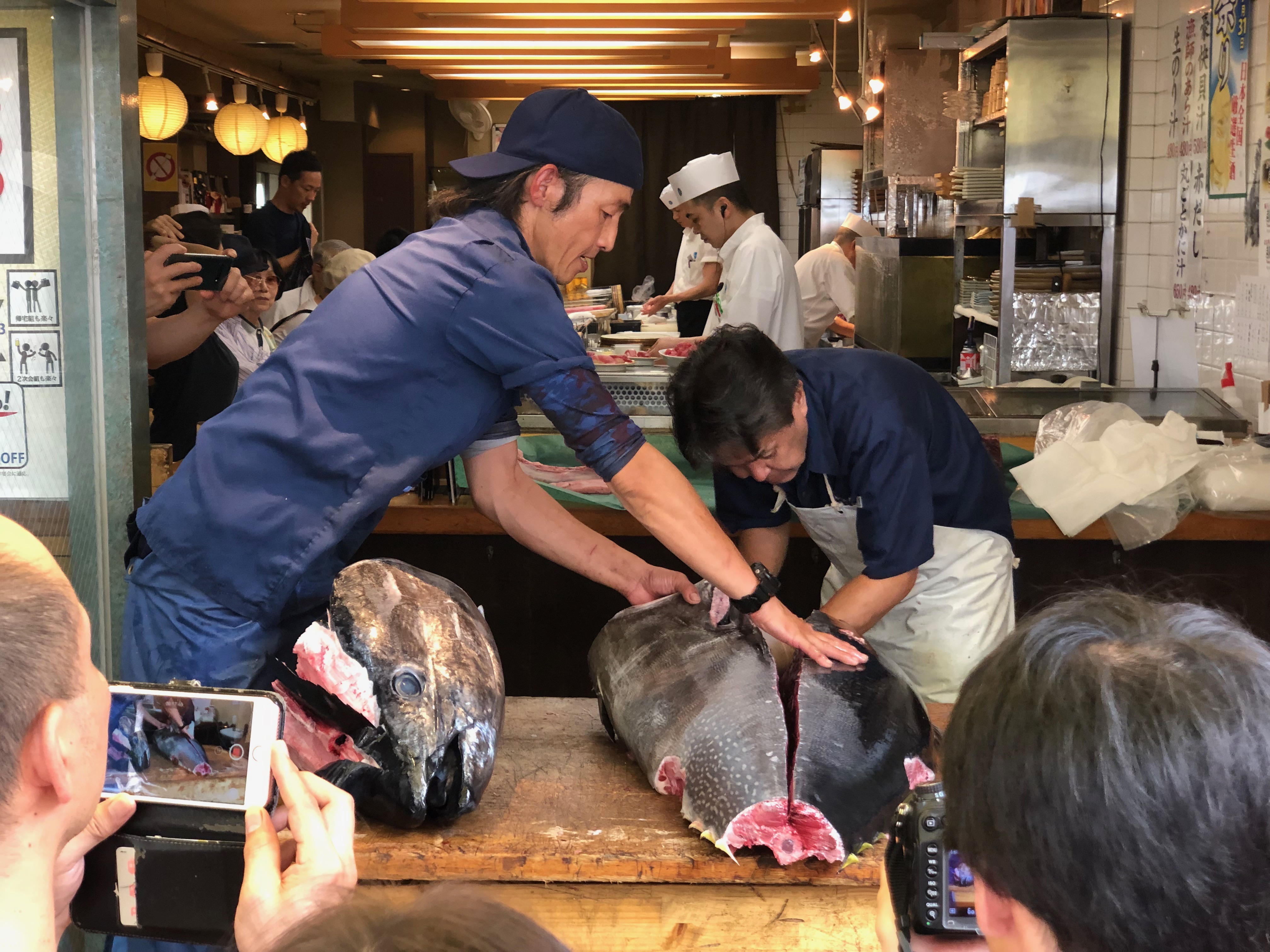
2 chefs cutting tuna in half 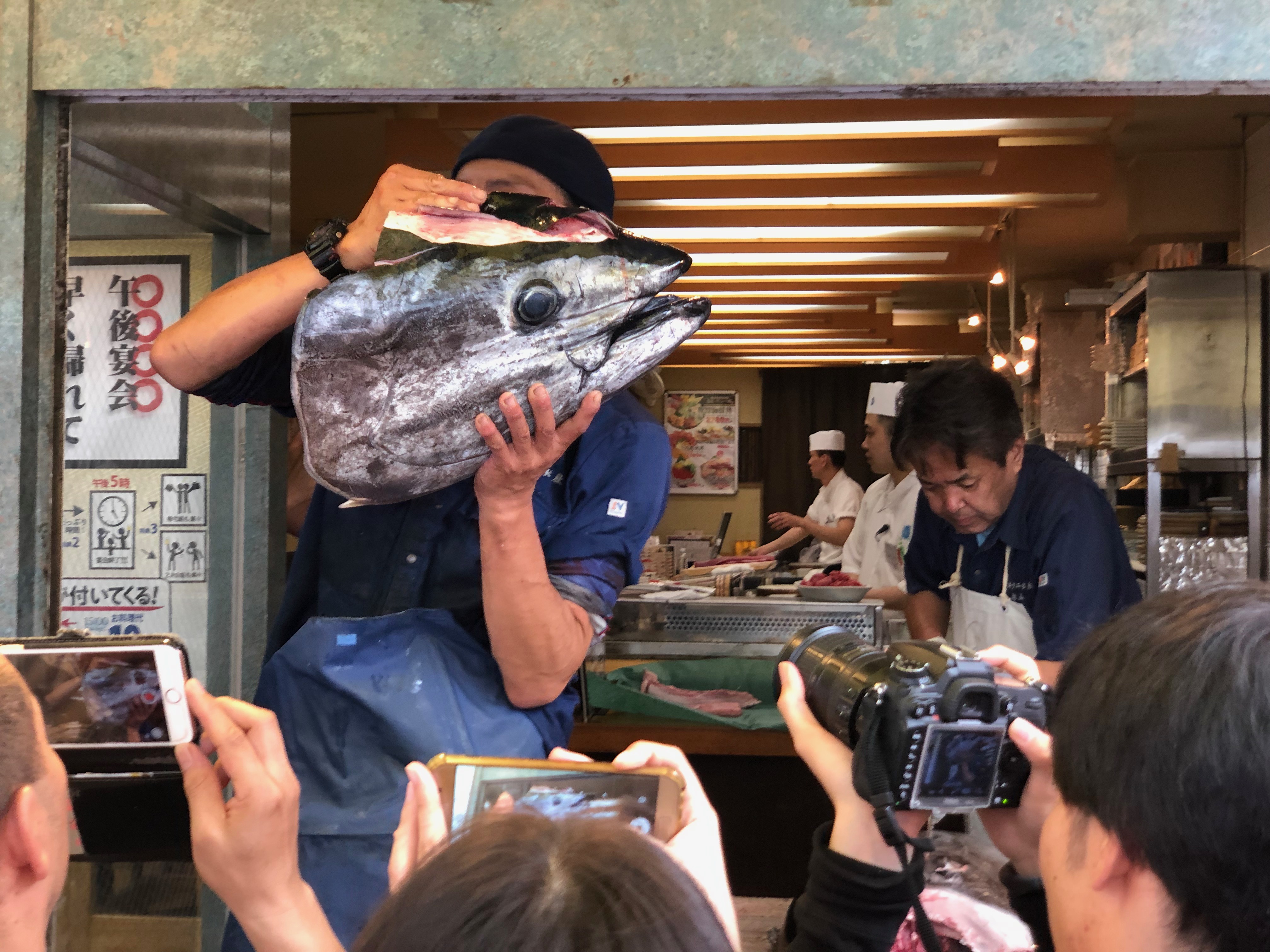
Showing off the head of the tuna fish 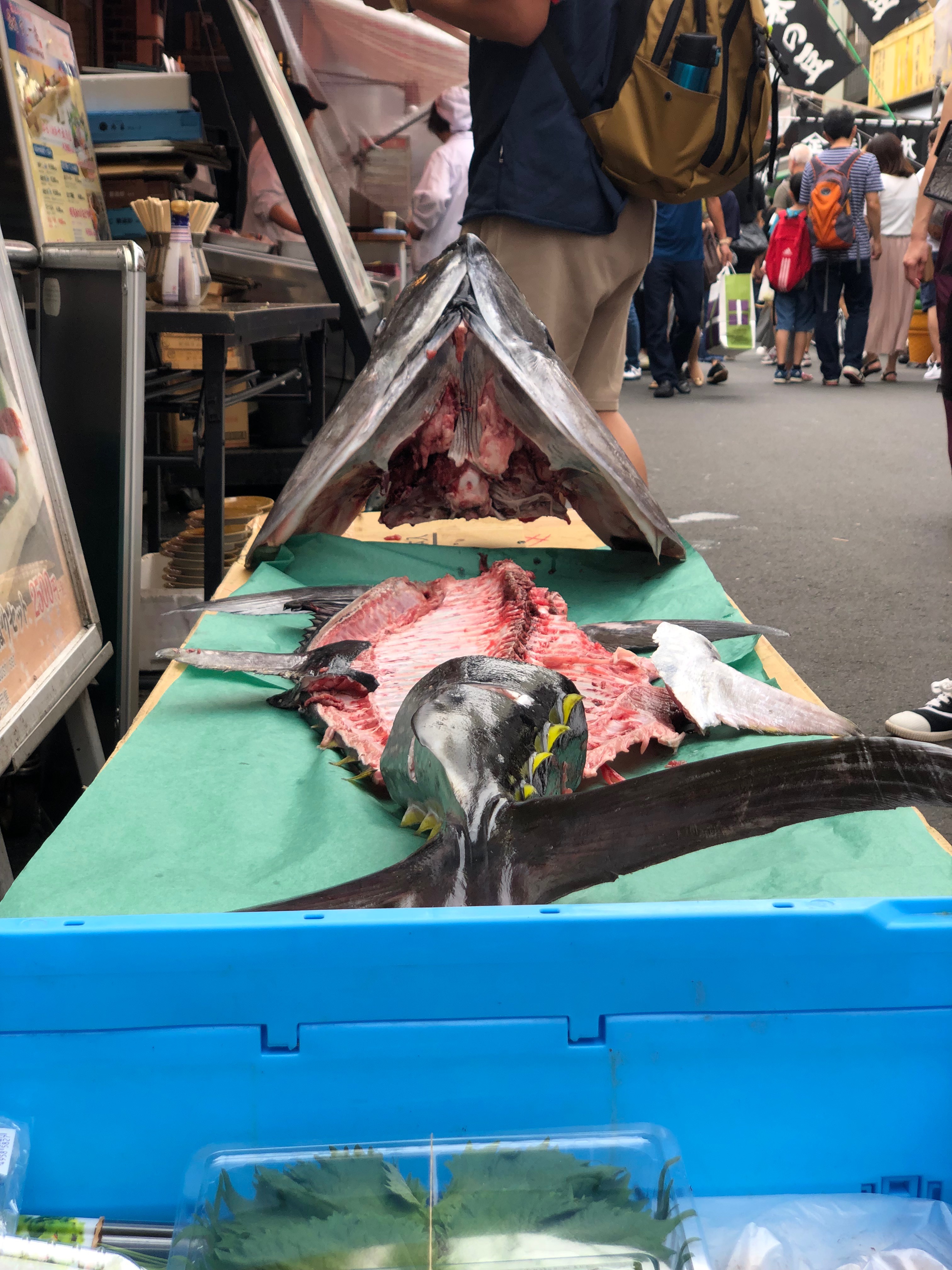
The remains of the tuna after all the sushi has been sold after the show
As I looked around for more food to try, I noticed a huge crowd consisting of both foreign and local people crowded around a store and knew instantly I had to check it out. Turns out, it was a tuna cutting show held by two chefs from a restaurant. This seemed to be a special show intended for anyone visiting Tsukiji market to see, as almost everyone in the crowd, whether they be local or foreign, was holding some sort of camera and recording the show. As the show ended, the tuna being cut up was sold as sushi to the audience, with many people lining up to have a bite at the fresh tuna sushi. This show was middle of the spectrum when it came to attracting tourists both local and foreign. While the demonstration was entirely in Japanese, knowledge of Japanese was not required to understand what was happening for most of the show.
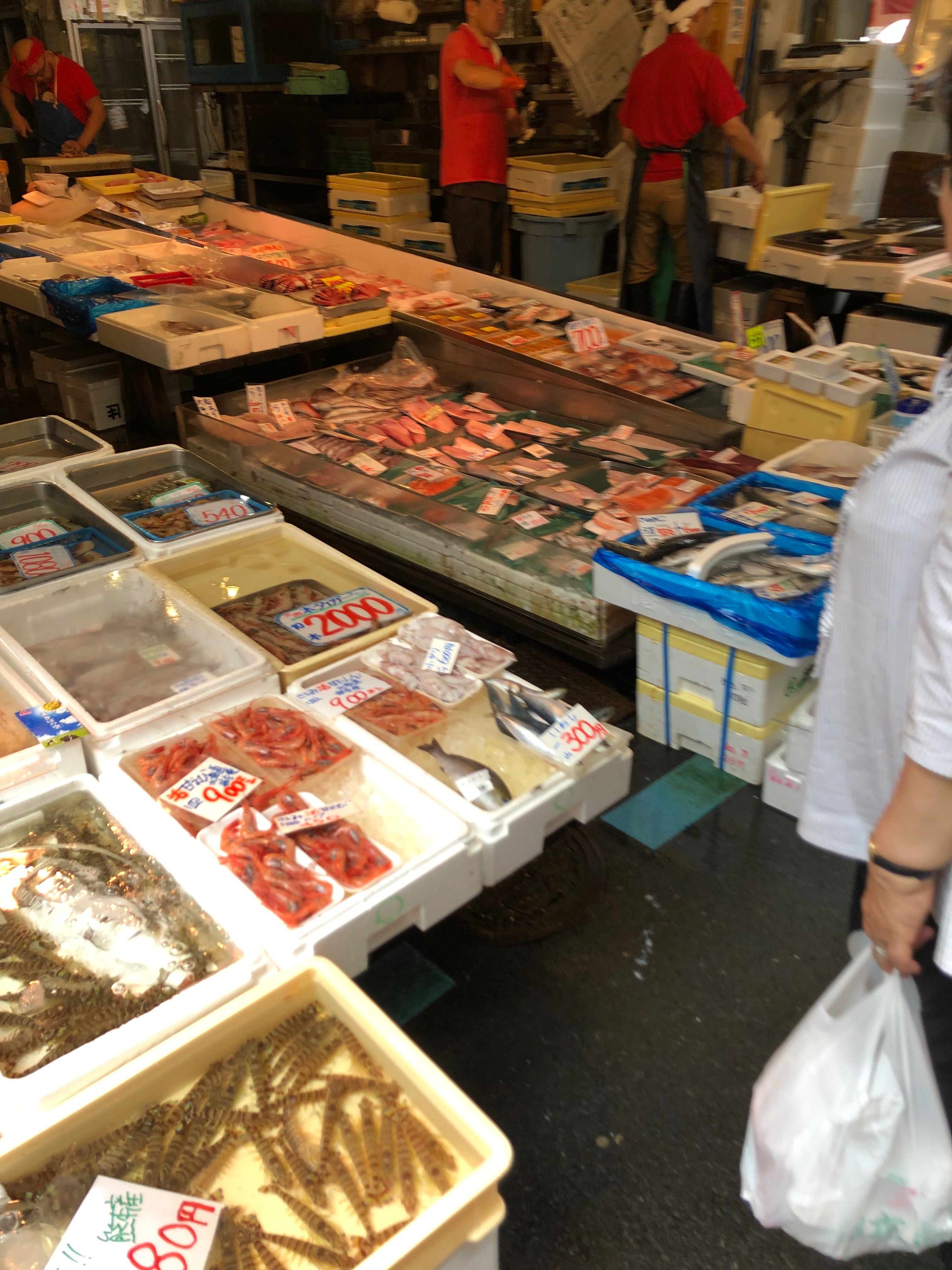
One of the stores selling a wide variety of seafood at the market 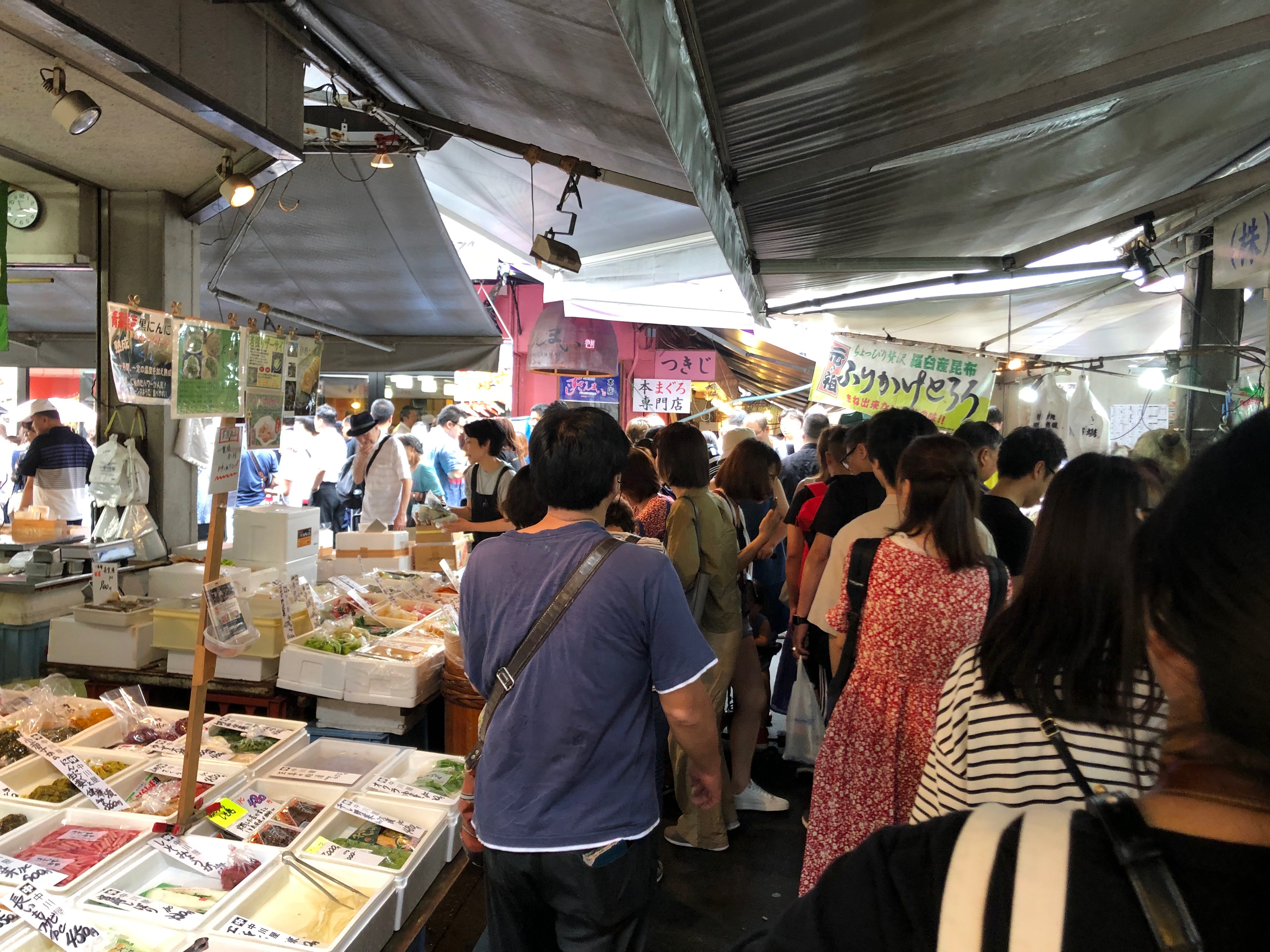
Crowds of Japanese people around the markets, with little tourists stopping to have a look
While Tsukiji fish market is a popular tourist destination, it started off and still is a fish market and that can still be seen when walking down certain streets. It was very obvious that these streets were made for locals to buy food to bring home and cook as the signs were generally just in Japanese, and the people visiting the stores were mainly locals as well, with most foreign tourists only choosing to walk through the street in order to get to the next touristy thing to do in Tsukiji. As such, the photos of the storefronts are generally blander, with little to no foreign languages, as the store owners themselves do not aim to attract tourists to visit and buy from their shop, unlike the restaurants and street vendors around Tsukiji.
Being in Tsukiji for a few hours, one can see how each store caters to their own audiences and how it does so through its strong visuals and ease of accessibility for tourists or lack thereof depending on their intended audience. The way stores here advertise and sell their product is similar to most other tourist destinations in Japan, such as in Miyajima, in which we discussed in class how stores would look vastly different depending on who its intended audience is.
Tominaga, Takaki. “New documentary on Tsukiji fish market captures essence of nation’s ‘lively kitchen’.” The Japan Times, 23 July 2016, http://www.japantimes.co.jp/culture/2016/07/23/films/new-documentary-tsukiji-fish-market-captures-essence-nations-lively-kitchen/.


 Mike in Japan
I thought it was very interesting how such a simple local place can turn into a tourist attraction. Given that when you tell me oh its just a fish market, nothing drives through my mind that makes it definitive from other fish markets, yet they were able to create a visual rhetoric to attract tourists. Besides the bright ads, why do you think that it was this market that won the bid and gain so many tourists instead of many others, when most fish markets are just trying to sell fish?
LikeLike
I think the popularity of this fish market started mainly due to its tuna auctions, as they were the main reason why tourists would visit. Stores around the area took advantage of their close location to the markets and the influx of visitors due to these auctions to attract tourists to their stores. The visuals are there mainly to differentiate who their audience is as well as to attract tourists to visit their store.
LikeLike
I found this fish market reminds me a lot the fish market we have in Seattle- Pike Place Market. It is a famous place for foreign travelers and local people. The difference is that most people who live in Seattle typically won’t go to this market to purchase everyday goods but it is definitely a tourist place for international travelers and US travelers. Do you think some stores in Tsukiji target consumers are Japanese travelers? Or this place is more gear towards residents around the market and foreign travelers?
LikeLike
Japan is definitely known for their seafood so it makes sense that they have a very tourist-friendly town centered around the local fish markets. I, too, wonder if the intended market for this consists of many local residents or if the focus entirely revolves around tourism – both domestic and foreign. Is it all just an elaborate show that is superfluous to the actual catching and distribution/sale of the fish?
LikeLike